Planetary & Exoplanetary ScienceIn the second semester of the year at USQ, in the depths of the Australian winter, I teach my second level course 'Planetary and Exoplanetary Science'. This course builds on the work students did in my first year course, Astronomy 1, and is where I get to take students on a journey through my own favourite parts of astronomy - the study of our Solar system, and of planetary systems orbiting other stars.
Over the ten teaching weeks of the course, students gain an in-depth introduction to the key concepts behind planetary and exoplanetary science, including the results of space exploration of the Solar system and the discovery and characterisation of planets and planetary systems orbiting stars other than the Sun. The course begins with a brief history of planetary science, before introducing the core mathematical concepts that form the fundamental framework on which our modern understanding of the field is constructed, in week two. Over the four weeks that follow, the students learn all about our Solar system, studying the terrestrial planets, the giant planets, and the many and varied small bodies that litter the space between the planets - leftovers from our Solar system's youth. We then use the information learned about our Solar system through those weeks to discuss our current best understanding of how the Solar system formed, and evolved to its current state. Once our voyage through the Solar system is complete, we turn our gaze outwards, and spend two weeks discussing all we have learned about planets beyond the Solar system in the first three decades of the Exoplanet Era, before looking to the future, and to the search for life beyond the Solar system. The course content for Planetary and Exoplanetary Science is delivered in pre-recorded lectures, which are then discussed by myself and the students in weekly two-hour tutorials. Those tutorials are held at USQ's Toowoomba campus, with remote students connecting in to participate using Zoom. |
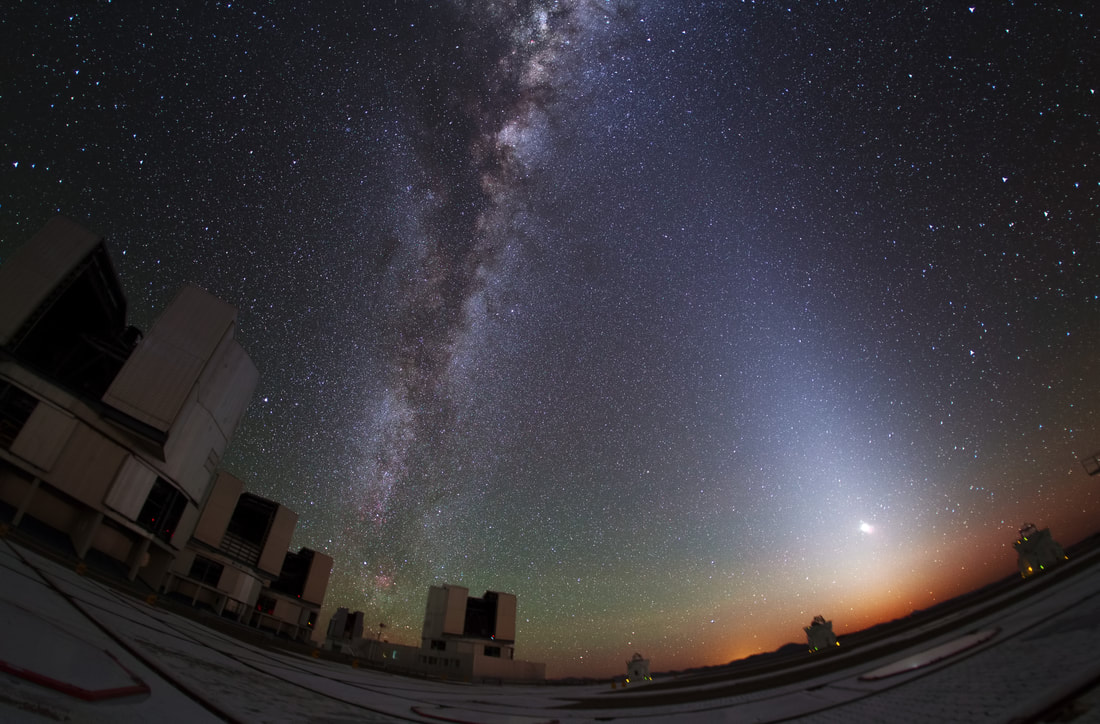
The Zodiacal Light, caused by dust scattered through the inner Solar system scattering sunlight, as seen alongside the Milky Way from Paranal Observatory, in Chile; Image Credit: ESO/Y. Beletsky, CC BY 4.0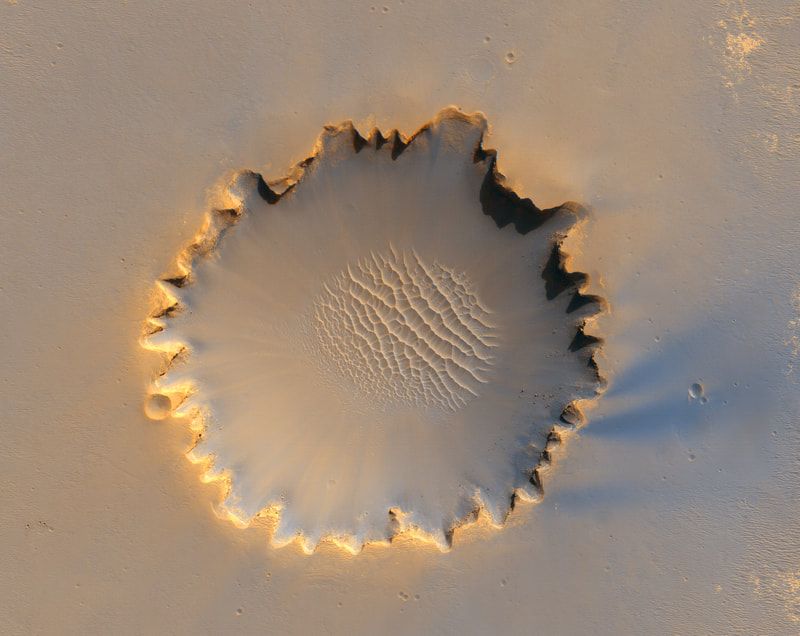
Victoria Crater, Mars, as imaged by the High Resolution Imaging Science Experiment, HIRISE, on Mars Reconnaissance Orbiter. Zoom in, and see if you can spot the Opportunity Rover, parked on the crater's rim! Image Credit: NASA/JPL/University of Arizona, Public DomainAmazing video, courtesy of SYSTEM Sounds, showing the journey to the discovery of the 4000th exoplanet through the first three decades of the Exoplanet Era. I really recommend watching with the volume up! |